Download the CfP!
[UPCOMING]
TrAdE V: “Dis-Place-Ment: Spatial, Linguistic, Literary and Psychophysical
Un-settlements”
Online, 19-20 November, 2026
TrAdE invites contributions for its V International Conference, to be held online on 19-20 November 2026. This conference aims to explore the concept of dis-place-ment through the lens of translation and adaptation from and into English, considering the interplay between language, literature, space, and identity, approached through the prism of its three constituent elements:
– the prefix dis-, with its privative, negative, or reversing force;
– the notion of place, both physical and mental;
and – the suffix -ment, indicating process or result.
We encourage interdisciplinary dialogue across Translation Studies, Adaptation Studies, Literature, Linguistics, Cultural Studies, Psychology, Neurolinguistics, and related fields, with a focus on how processes of translation and adaptation mediate, reflect, or challenge experiences of displacement.
We invite proposals in English that address, but are not limited to, the following areas:
1. Dis-: Privation, Negation, and Reversal in Translation and Adaptation
● Spatial and cultural displacement in translated/adapted texts: migration, exile, and the politics of un-belonging.
● Institutional and linguistic negation: exclusionary practices, the creation of “non-places,” and the erasure or transformation of voices in translation/adaptation.
● Linguistic dissociation: semantic shifts, language loss, or the emergence of new forms in contexts of displacement, including the adaptation of culturally specific concepts and the negotiation of untranslatability.
2. Place: Physical and Mental Geographies in Interlingual and Intercultural Transfer
● Attachment/detachment in translation: the trauma of uprooting and nostalgia as experienced or represented in translated/adapted works.
● Transitory and liminal spaces: the role of translation/adaptation in constructing or mediating refugee camps, tourist spaces, digital environments, and other “in-between” places.
● Voluntary Displacement: tourism, leisure mobility, and their translation/adaptation.
● Forced Displacement: migration, asylum, and their translation/adaptation.
● Symbolic remapping: redefining borders, centers, and peripheries through translation/adaptation, and the mental construction of space in the transfer between languages and cultures.
3. -ment: Psychophysical and Linguistic Processes in Adaptation and Translation
● Post-traumatic dissociation and identity fragmentation: the neurolinguistic and psychological effects of displacement.
● Regeneration through language: narrative strategies for grounding, the role of migrant poetry, storytelling, and adaptation as acts of resistance and reconstruction.
● Digital displacement: the formation of virtual communities and the impact of digital environments on translation/adaptation practices.
Confirmed Keynote Speakers: Dr. Katarzyna Czarnocka (University of Warsaw); Prof. Halina Marlewicz (Jagiellonian University, Institute of Oriental Studies)
Please submit your abstract (max 300 words) or panel proposals, including title, author affiliation, and 5 keywords, plus a short bio to segreteria.trade@gmail.com.
Submission deadline: 15/9/2026
Notifications of acceptance: by 5/10/2026
[New Publication]
February 2025
https://vernonpress.com/book/2191
[UPCOMING]
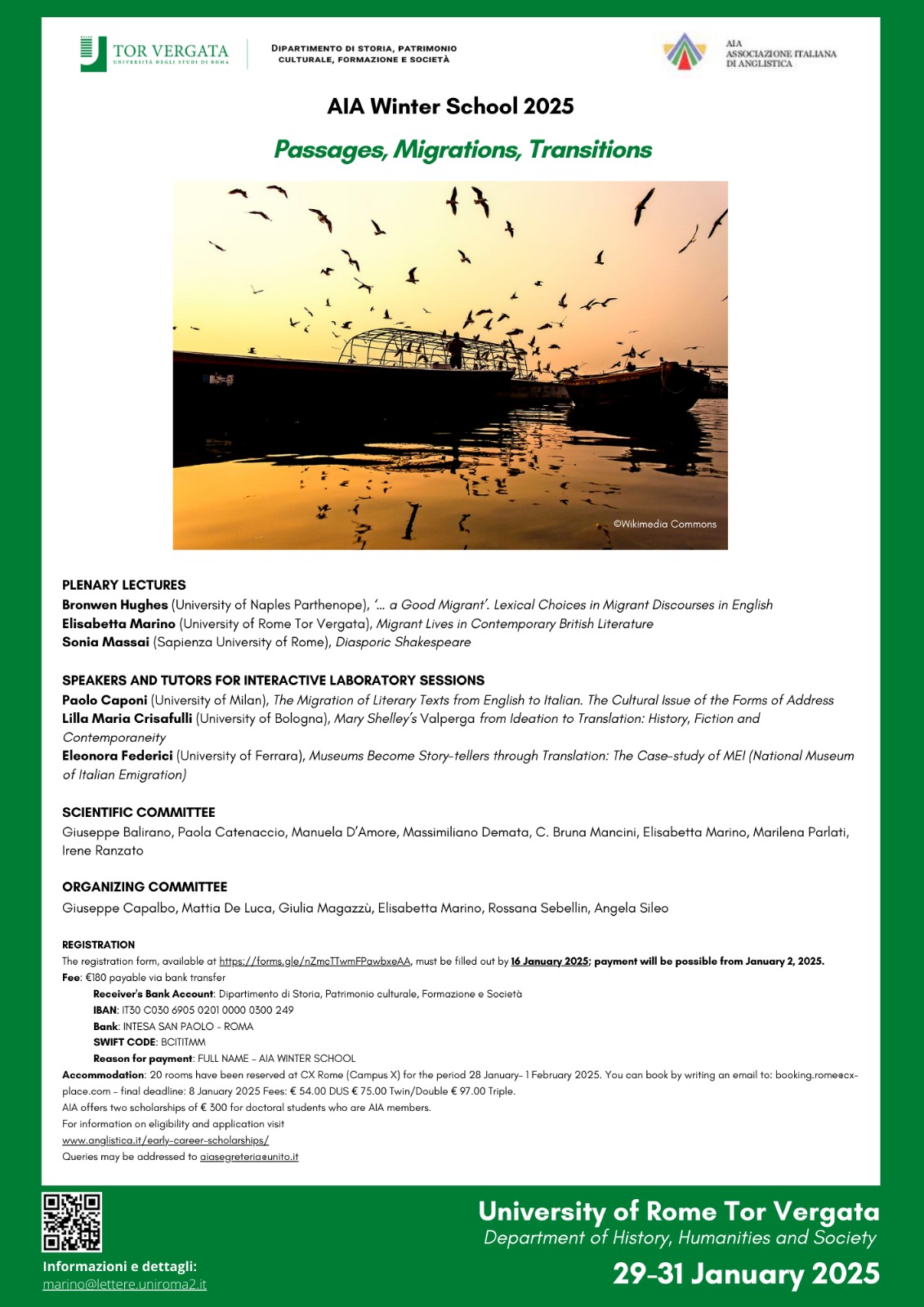
TrAdE (Translation and Adaptation from/into English) Research Group was established at the Department of History, Humanities and Society of the University of Rome “Tor Vergata”, in 2019.
The Research Group intends to explore adaptation studies as well as theoretical, descriptive, and applied translation, by focussing on both literary and multimedia products in the English-speaking field. By adopting a multidisciplinary perspective, TrAdE aims at bringing new insights and innovations in the above-mentioned domains.
In addition to regular meetings, the Research Group organises seminars and an annual conference (selected papers are published in volumes and journals). Furthermore, it works in partnership with national and international researchers and institutions.